
October 2, 2026
8 Rare Classic Cars Still Registered in the UK in 2026
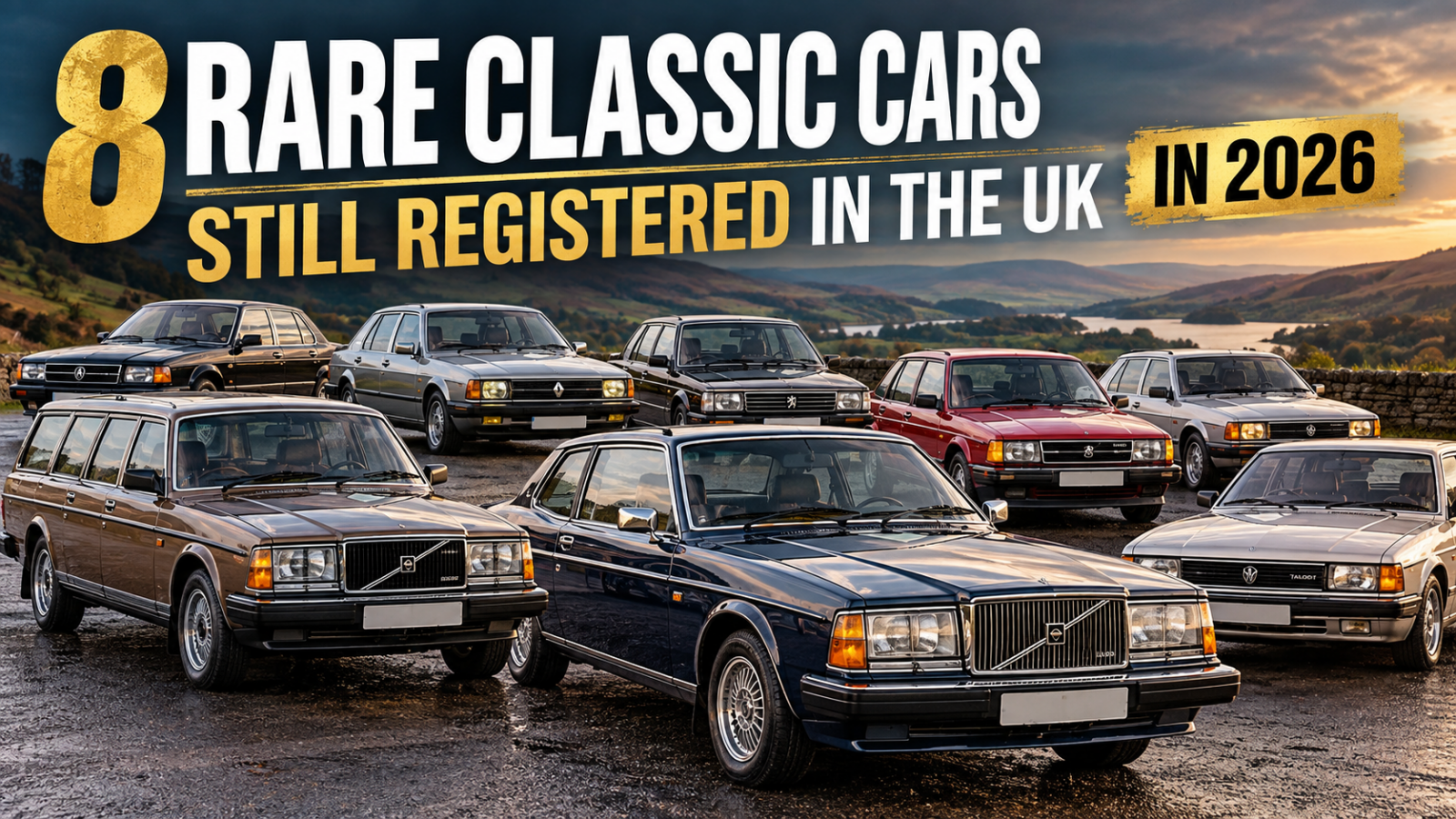
Some classic cars are instantly familiar. Others have become so scarce that seeing one on a British road now feels like an event in itself.
Cars that once filled dealership windows, company car parks and motorway service stations can disappear surprisingly quickly. Low original sales, corrosion, expensive repairs, limited parts availability and years of being regarded as simply old rather than collectible can reduce a production model to only a handful of surviving examples.
So, how many rare classic cars are actually left in the UK in 2026?
Using the latest available UK vehicle licensing statistics, we looked at eight particularly interesting classic cars and checked how many currently hold a road licence and how many sit on SORN.
The list includes forgotten French flagships, unusual executive cars and two rare Volvos with a particularly close connection to Direct Classics.
How Do We Know How Many Classic Cars Are Left in the UK?
For this article, we used UK vehicle licensing statistics from Department for Transport and DVLA data.
The latest available figures for the cars below cover Q1 2026. The data separates vehicles into two main categories:
- Licensed: vehicles with a current licence for use on public roads.
- SORN: vehicles whose owners have made a Statutory Off Road Notification and do not currently use them on public roads.
Historic vehicle data does have limitations. Older cars do not always appear under consistent model descriptions on their registration documents. Imported vehicles, different trim descriptions and historic registration practices can cause the same basic model to appear under several classifications.
We therefore use these figures as a strong indication of rarity rather than an exact census of every surviving car.
Rare Classic Cars Recorded in the UK in 2026
| Classic Car | Licensed | SORN | Total Recorded |
|---|---|---|---|
| Talbot Tagora | 2 | 6 | 8 |
| Volvo 265 GLE Auto | 9 | 11 | 20 |
| Renault 30 | 11 | 16 | 27 |
| Peugeot 604 | 11 | 24 | 35 |
| Saab 90 | 10 | 30 | 40 |
| Volvo 262 C Auto | 16 | 34 | 50 |
| Talbot Solara | 12 | 40 | 52 |
| Vauxhall Royale | 34 | 35 | 69 |
These figures use Q1 2026 UK licensing data. They show vehicles under the relevant DVLA model classifications, so they may not include every surviving physical example.
1. Talbot Tagora: 8 Recorded
Licensed: 2 | SORN: 6 | Total recorded: 8
Few executive cars demonstrate how quickly a mainstream production model can almost disappear better than the Talbot Tagora.
The Tagora began life as a Chrysler Europe project before PSA took control of the company. It eventually reached the market under the Talbot name in the early 1980s, entering an executive-car sector already dominated by established British and German manufacturers.
Its production life proved brief, and today the UK survivor figures look extraordinary.
Q1 2026 licensing data lists just eight Talbot Tagoras across the model family. Only two currently hold a road licence, while the owners of six have declared them SORN.
Individual versions are even scarcer. The Tagora GLS accounts for one licensed example, while the Tagora SX accounts for the other.
The Tagora shows how rarity does not always begin with exclusivity. Cars without a strong collector following often disappeared rapidly while enthusiasts still regarded them as ordinary ageing vehicles.
For anyone who remembers seeing Tagoras on British roads in the 1980s, the fact that only two currently hold a road licence is remarkable.
2. Volvo 265 GLE Auto: 20 Recorded
Licensed: 9 | SORN: 11 | Total recorded: 20
Large Volvo estates eventually became one of the Swedish manufacturer’s most recognisable products, but the Volvo 265 GLE was considerably more unusual than the four-cylinder estates normally associated with the 200 Series.
The 265 combined Volvo’s practical estate body with the more luxurious 260 Series specification. It also used a V6 from the PRV engine family, which Peugeot, Renault and Volvo developed together.
The surviving UK population of the automatic 265 GLE is now remarkably small.
At the end of Q1 2026, the data lists just nine licensed Volvo 265 GLE Automatics, while another 11 cars sit on SORN.
That gives a total recorded population of only 20 cars under this particular DVLA model description.
The historical figures show just how dramatic the decline has been. At the end of 1997, the same classification listed 929 licensed examples. Fewer than three decades later, the figure stands at nine.
Direct Classics has first-hand experience with this model through our own Volvo 265 GLE restoration project. The car had spent almost 30 years in storage before entering our workshop for a full assessment and restoration programme.
Follow our Volvo 265 GLE restoration project
3. Renault 30: 27 Recorded
Licensed: 11 | SORN: 16 | Total recorded: 27
The Renault 30 represented an ambitious move upmarket for Renault during the 1970s.
Rather than following the conventional three-box executive saloon formula, Renault created a large five-door hatchback and equipped the 30 with the PRV V6 developed jointly by Renault, Peugeot and Volvo.
The concept looked unusual at the time. A large front-wheel-drive executive hatchback offered considerable practicality, but Renault faced strong competition from established prestige manufacturers.
Today, the UK survivor figures show just how uncommon the model has become.
Latest 2026 licensing statistics list 27 Renault 30s: 11 licensed cars and 16 on SORN.
What once looked like an unconventional approach to the executive market now seems surprisingly modern. Large hatchbacks and liftbacks later became far more familiar, making the Renault 30 an interesting example of a manufacturer pursuing a different formula before the wider market embraced it.
4. Peugeot 604: 35 Recorded
Licensed: 11 | SORN: 24 | Total recorded: 35
The Peugeot 604 shared part of its engineering story with the Renault 30 but approached the executive market very differently.
Peugeot introduced the 604 during the mid-1970s as a substantial rear-wheel-drive saloon designed to take the company back into the upper end of the European car market.
Early V6 versions used the same PRV engine family associated with Renault and Volvo, while later 604s expanded the range with fuel-injected V6 and diesel variants.
Despite its significance within Peugeot’s history, the 604 has become extremely uncommon in Britain.
Q1 2026 figures list just 35 Peugeot 604s across the model family: 11 licensed and 24 on SORN.
Some individual specifications are scarcer still, with only a handful of examples remaining under certain trim and engine classifications.
The Peugeot 604, Renault 30 and Volvo 260 family also show how three manufacturers could use the same basic V6 engine while creating cars with very different personalities.
5. Saab 90: 40 Recorded
Licensed: 10 | SORN: 30 | Total recorded: 40
The Saab 90 never became as familiar as the 99 or 900, partly because it occupied a relatively short period in Saab’s history.
Saab introduced the 90 during the mid-1980s as the company moved towards a newer generation of models.
Its UK population has since fallen dramatically.
At the end of Q1 2026, just 10 Saab 90s held a road licence, while another 30 appeared on SORN.
The historical figures reveal the scale of the decline. At the end of 1994, the UK licensing data listed 829 Saab 90s with a current road licence.
That means the licensed population has fallen from hundreds of cars to just ten.
Many models suffered their greatest losses after buyers stopped viewing them as desirable modern cars but before enthusiasts began valuing them as classics.
The surviving Saab 90s therefore tell us as much about changing attitudes towards preservation as they do about the car itself.
6. Volvo 262C Bertone: 50 Recorded Under the Automatic Classification
Licensed: 16 | SORN: 34 | Total recorded: 50
The Volvo 262C Bertone has a particularly close connection to Direct Classics because our collection includes a 1979 example.
The 262C differed significantly from the conventional Volvo 200 Series. Volvo designed the car in Sweden before Bertone in Turin, Italy carried out the specialist body production.
Bertone substantially lowered the roofline, altered the windscreen angle and transformed the body into a distinctive two-door luxury coupé.
Volvo produced only 6,622 examples of the 262C between 1977 and 1981.
UK licensing statistics demonstrate how uncommon the model has now become.
For Q1 2026, the specific DVLA classification VOLVO 262 C AUTO lists just 16 licensed cars and 34 on SORN.
That gives a total of 50 vehicles under this particular automatic model classification.
The DVLA data also contains a separate VOLVO 262 C classification. We therefore cannot say that exactly 50 Volvo 262Cs survive in Britain. However, the figures clearly show how small the UK population has become.
Our own 1979 Volvo 262C Bertone uses the earlier 2,664 cc B27E V6, paired with a three-speed automatic transmission, and shows just 21,983 recorded miles.
Explore our 1979 Volvo 262C Bertone
7. Talbot Solara: 52 Recorded
Licensed: 12 | SORN: 40 | Total recorded: 52
The Tagora was not the only Talbot model to become a rare sight on British roads.
The Talbot Solara arrived at the beginning of the 1980s as a four-door saloon related to the Talbot Alpine.
Talbot designed the Solara as a practical family and company car rather than an exotic or expensive model.
That is precisely what makes its survival figures so interesting today.
Q1 2026 data lists 52 Talbot Solaras across the model family: only 12 licensed and 40 on SORN.
The numbers demonstrate an important point about classic-car survival. Ordinary cars can become considerably rarer than prestigious models.
Family cars often covered high mileages, endured British winters and eventually reached a point where repair costs exceeded their modest values. Few owners imagined that an everyday saloon might one day become a scarce historic vehicle.
Today, seeing a surviving Solara on the road is considerably less ordinary than its designers ever intended.
8. Vauxhall Royale: 69 Recorded
Licensed: 34 | SORN: 35 | Total recorded: 69
The Vauxhall Royale represented Vauxhall at the upper end of the market from the late 1970s.
Closely related to the Opel Senator and Monza, the Royale brought large-engine, rear-wheel-drive executive motoring to the British Vauxhall range.
Although Vauxhall never sold it in the numbers achieved by its mainstream models, the Royale was once considerably more familiar than it is today.
Q1 2026 figures list 69 Vauxhall Royales across the model family: 34 licensed and 35 on SORN.
The almost even split between licensed and SORN cars is interesting because it shows why road-licensed figures alone cannot tell us the full story.
A SORN vehicle may be undergoing restoration, sitting in long-term storage, forming part of a private collection or simply spending the winter off the road.
Why Do Once-Common Cars Become So Rare?
There is no single reason why one model survives while another almost disappears.
Some cars on this list were relatively uncommon from the beginning and therefore started with a small UK population. Others sold in meaningful numbers but suffered dramatic losses as they aged.
Low Values Can Work Against Survival
When an ageing car is worth less than the cost of repairing serious corrosion, an automatic gearbox failure or major engine problems, owners face a difficult financial decision.
Many cars disappear during this stage of their lives.
If values later rise and enthusiast interest grows, surviving examples suddenly become worth restoring. By then, however, much of the original population may already have disappeared.
Rust and British Weather
Cars used throughout British winters faced moisture, road salt and years of exposure that could cause severe corrosion.
Even mechanically durable cars could suffer major structural deterioration, particularly when low values made extensive body restoration difficult to justify.
Parts Availability
Sharing mechanical components with higher-volume models can make a rare car easier to keep on the road.
Unique body panels, glass, trim pieces and interior fittings can cause far greater problems.
A single unavailable trim piece or body panel can therefore delay the restoration of an otherwise repairable car.
Some Cars Became Collectible Earlier Than Others
Sports cars, prestige models and vehicles with strong enthusiast followings often attracted preservation much earlier in their lives.
Ordinary saloons, estates and hatchbacks did not always receive the same treatment.
That helps explain why an everyday family car from the 1970s or 1980s can sometimes be much harder to find today than a far more expensive sports car from the same period.
Does SORN Mean a Classic Car Is Abandoned?
No. SORN simply means Statutory Off Road Notification.
An owner uses SORN to tell the DVLA that they are keeping a vehicle off public roads and do not currently need to tax it.
A SORN classic could be:
- undergoing restoration;
- part of a private collection;
- stored over winter;
- awaiting mechanical work;
- undergoing recommissioning after long-term storage; or
- a complete car that its owner has temporarily taken off the road.
This is why we consider both licensed and SORN figures when assessing how many examples of a classic model may still survive.
Are DVLA Survivor Figures Completely Accurate?
No database can count every surviving physical classic car perfectly.
UK licensing statistics rely on the make and model information held against each vehicle’s registration record.
This becomes more complicated with older cars. Different registration descriptions, imported vehicles and historic data-entry practices can place very similar cars under separate model classifications.
Some cars that have remained off the road for decades may also sit outside the modern data in ways that make simple comparisons difficult.
For that reason, we prefer precise wording. For example:
“16 Volvo 262 C Auto models appeared as licensed in Q1 2026.”
That is more accurate than claiming that only 16 Volvo 262Cs physically exist in Britain.
The figures still provide an excellent guide to rarity, but they need careful interpretation.
Can Rare Classic Car Numbers Increase?
Yes.
A small population does not necessarily continue shrinking every year.
Once a model becomes sufficiently rare, enthusiasts are more likely to recognise its significance and invest in maintenance or restoration.
Owners can also return cars from SORN to the road after restoration or recommissioning. Imports may add further examples to the UK population, while cars hidden in long-term storage can occasionally reappear after decades.
So the more interesting question is not simply how many cars remain, but how many owners are actively preserving them.
Frequently Asked Questions About Rare Classic Cars in the UK
How many classic cars are left in the UK?
There is no single definitive figure because the term “classic car” does not refer to one individual DVLA vehicle category. The number depends on the definition used, such as vehicle age, historic tax status or enthusiast classification.
DVLA statistics can, however, show how many examples of individual makes and models appear as licensed or SORN.
What does SORN mean?
SORN stands for Statutory Off Road Notification. It tells the DVLA that an owner is keeping a vehicle off public roads and does not currently need to tax it.
Are How Many Left figures accurate?
They provide a useful guide because they draw on UK vehicle licensing statistics, but they cannot count every physical survivor perfectly.
Historic cars may appear under different model names or classifications within DVLA records, so we treat the figures as an indication of rarity rather than a complete census.
How many Volvo 262Cs are left in the UK?
For Q1 2026, the DVLA classification VOLVO 262 C AUTO lists 16 licensed vehicles and 34 on SORN.
A separate VOLVO 262 C classification also exists, so the automatic figure does not represent the complete UK population of every Volvo 262C.
How many Volvo 265 GLE Automatics are left in the UK?
Q1 2026 statistics list nine licensed Volvo 265 GLE Automatics and a further 11 on SORN, giving 20 vehicles under that specific model classification.
Why are some ordinary classic cars rarer than expensive classics?
Everyday cars often covered high mileages and had little financial incentive for preservation when they became old.
Expensive sports and luxury cars were more likely to receive careful storage, maintenance and restoration. As a result, some once-common family cars now survive in remarkably small numbers.
Can a SORN classic car return to the road?
Yes. Owners regularly return classic cars to the road after restoration, repair or long-term storage. A car can therefore move from the SORN population back into the licensed figures.
Preserving Britain’s Less Obvious Classic Cars
Classic-car history is about far more than the models that command the highest auction prices.
The Talbot Tagora, Renault 30, Peugeot 604, Saab 90 and other cars featured here each represent different manufacturers, engineering ideas and periods of automotive history.
With some models now represented by only a handful of licensed cars, preserving the remaining examples matters.
Our own 1979 Volvo 262C Bertone provides a good example. Its unusual combination of Volvo engineering and Bertone production gives it an important place in Volvo’s history, while current UK licensing data shows how uncommon the model has become.
The same applies to our Volvo 265 GLE project. Cars that people once dismissed as simply old can become increasingly significant as the surviving population falls.
At Direct Classics, we are interested in unusual, significant and increasingly difficult-to-find cars, whether carefully preserved, awaiting recommissioning or undergoing the next stage of their restoration.
Sources and Data
We used the latest available Q1 2026 UK vehicle licensing data when preparing this article. The figures show vehicles under specific DVLA model classifications and should serve as an indication of rarity rather than an exact physical survivor count.
- How Many Left – UK vehicle licensing statistics
- How Many Left – Volvo 262 C Auto
- How Many Left – Volvo 265 GLE Auto
- How Many Left – Saab 90
- The Classic Valuer – Talbot Tagora survivor data
- The Classic Valuer – Renault 30 survivor data
- The Classic Valuer – Peugeot 604 survivor data
- The Classic Valuer – Talbot Solara survivor data
- Rarity Radar – Vauxhall Royale survivor data
Data checked October 2026 using the latest Q1 2026 figures available at the time of publication. We recommend updating this article when new quarterly licensing statistics become available.
Comments
Seen one of these?