
October 15, 2026
How to Start a Classic Car That Has Been Sitting for Years: 12 Checks Before You Turn the Key
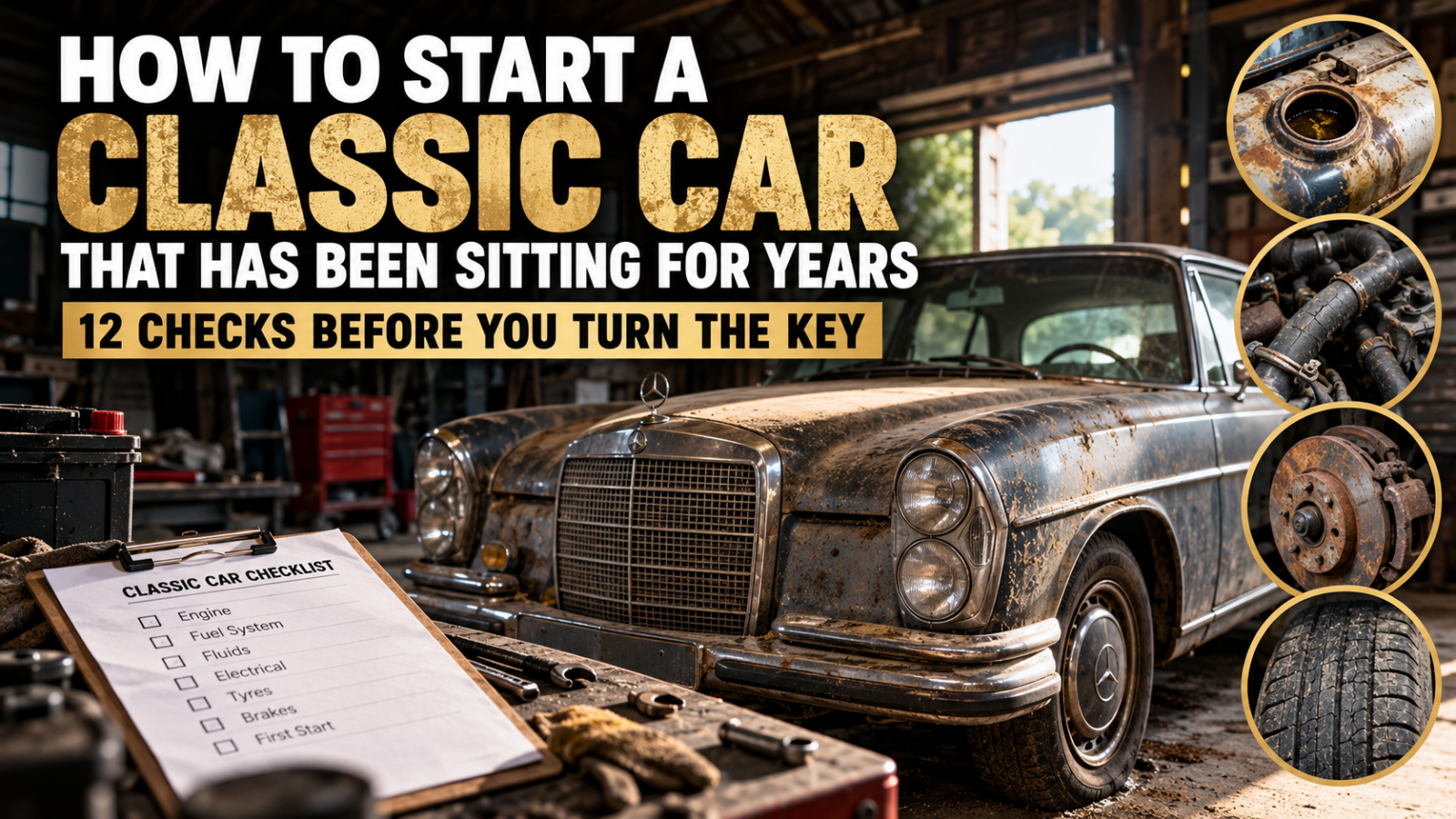
Finding a classic car that has been sitting for years creates an obvious temptation: fit a battery, turn the key and see what happens.
That should rarely be the first step.
A car can look complete while hiding stale fuel, dry seals, seized brakes, damaged wiring, old tyres or an engine that no longer turns freely. Trying to start it immediately can turn a manageable recommissioning job into a much larger repair.
So, how do you start a car that has been sitting for years?
The safest approach is to inspect the car first, establish why it stopped being used and work through each major system before attempting a first start.
| QUICK ANSWER Do not begin with the ignition key. Find out why the car was parked, check whether the engine turns, inspect the fuel and fluids, examine the wiring and then assess the brakes and tyres before attempting a start. |
This guide covers 12 important checks before you turn the key, whether the car has spent a few years in a garage or several decades hidden away in storage.
Contents
Starting a Classic Car After Long-Term Storage: Quick Checklist
| STEP | CHECK | WHY IT MATTERS |
|---|---|---|
| 1 | Why was it parked? | The car may have entered storage because of an existing mechanical fault. |
| 2 | Visual inspection | Look for leaks, rust, rodents, damaged wiring and obvious deterioration. |
| 3 | Does the engine turn? | Do not repeatedly crank a seized or tight engine with the starter. |
| 4 | Engine oil | Check the level and look for contamination before running the engine. |
| 5 | Fuel system | Old fuel, contamination and leaks can prevent a safe first start. |
| 6 | Fuel hoses | Age can cause rubber hoses, seals and connections to crack or leak. |
| 7 | Coolant and belts | Old rubber components may fail once heat and pressure return. |
| 8 | Electrical system | Rodents, corrosion and damaged insulation can create electrical faults. |
| 9 | Battery | A deeply discharged old battery may no longer provide reliable power. |
| 10 | Tyres | Old tyres can crack, harden and develop flat spots despite having tread. |
| 11 | Brakes | A running engine does not mean the car can stop safely. |
| 12 | First start | Watch oil pressure, temperature, leaks, smoke and unusual noises. |
| IMPORTANT
This article provides general guidance rather than a workshop procedure for every vehicle. Classic cars vary considerably in design. If you are unsure about the fuel system, brakes, electrical system or engine condition, ask a suitable specialist to inspect the car. |
1. Find Out Why the Car Was Parked
Before touching anything, try to discover why the car stopped being used.
This is one of the most useful pieces of information you can have when recommissioning a classic.
Some cars enter storage simply because an owner loses interest, moves house or stops driving. Others get parked because the engine overheated, the gearbox failed, the brakes developed a fault or another mechanical problem appeared.
Those situations require very different approaches.
If the previous owner says the car “ran when parked”, ask when that was and why they stopped using it.
A car that ran normally before six months of winter storage is very different from one that last moved under its own power 20 or 30 years ago.
Useful Information to Look For
| RECORD | WHAT IT CAN TELL YOU |
|---|---|
| Workshop invoices | Previous faults, repairs and major mechanical work. |
| MOT records | Mileage history, advisories and when the car last saw road use. |
| Service history | How regularly the car received maintenance before storage. |
| Parts receipts | Components that previous owners replaced or intended to replace. |
| Previous owner information | Why the car stopped being used and any known problems. |
2. Inspect the Whole Car Before Moving It
Start with a slow walk around the vehicle.
Look underneath for signs of:
- engine oil;
- gearbox or transmission fluid;
- coolant;
- brake fluid;
- fuel leaks; and
- heavy corrosion.
Then inspect the engine bay.
Long-term storage can attract rodents, particularly when a car has spent years in a barn, garage or rural building.
Look for nests, damaged insulation, chewed wiring and debris around the engine bay or air intake.
| DO NOT RELY ON A DRY FLOOR
A system that lost all of its fluid years ago may simply have nothing left to leak. |
Also check underneath the car for serious structural corrosion before attempting to jack it up or move it.
3. Check Whether the Engine Turns Before Using the Starter
This is one of the most important checks on a car that has spent many years standing.
An engine can become difficult or impossible to turn because of internal corrosion, mechanical failure or another problem.
Repeatedly operating the starter motor against an engine that will not rotate properly can damage components without solving the cause.
If you have the correct knowledge and tools for the particular engine, establish whether it turns manually before attempting a normal start.
If you do not know the correct procedure, ask a specialist to perform the check.
What If the Engine Will Not Turn?
Stop and investigate rather than applying more force.
An engine that will not turn does not automatically need replacement, but you need to understand why it has locked before deciding what happens next.
| POSSIBLE CAUSE | WHAT IT MAY MEAN |
|---|---|
| Internal corrosion | Moisture may have affected internal engine components during storage. |
| Previous mechanical failure | The engine may have stopped working before the car entered storage. |
| Seized component | An ancillary component or internal part may prevent normal rotation. |
| Unknown obstruction | Further inspection may be needed before applying additional force. |
A first-start attempt should never become a contest to see how long the starter motor will crank.
Direct Classics Case Study: Our Volvo 265 GLE
| DIRECT CLASSICS CASE STUDY
Our Volvo 265 GLE demonstrated exactly why checking the engine first matters. The car had spent many years in storage before arriving at Direct Classics. During the initial assessment, we discovered that the engine would not turn. Rather than repeatedly attempting to start it, we removed the engine so that we could inspect it properly. The condition of the original unit eventually led us to source a suitable donor car and engine for the project. The lesson was simple: getting an old car running should never take priority over finding out why it does not run. |
4. Check the Engine Oil
Check the oil level and condition before attempting to run the engine.
Look for anything unusual, including:
- a very low oil level;
- contamination;
- unusual colour or consistency; and
- signs that another fluid may have entered the oil.
Remember that servicing depends on time as well as mileage.
A car that has covered almost no miles during storage may still need fresh fluids because those fluids have aged while the vehicle stood.
For a vehicle that has spent years rather than months in storage, establish an appropriate servicing plan before relying on the engine.
5. Treat Old Fuel With Caution
Fuel changes during storage.
Petrol can lose useful properties over time, while moisture and contamination inside an old fuel system can create further problems.
Modern petrol containing ethanol can also affect some older fuel-system materials.
Do not assume that fuel which has sat in a tank for years remains suitable simply because the tank still contains fuel.
Inspect the fuel and the condition of the system before attempting to run the car.
| OLD FUEL WARNING
Very old or contaminated fuel needs proper attention. Fuel removal and disposal involve fire and environmental risks, so use suitable equipment or professional help if you are unsure. |
Should You Just Add Fresh Petrol?
That depends on how long the car has stood and the condition of the fuel already in the tank.
A vehicle returning after a relatively short storage period may only require routine checks and fresh fuel.
A car that has spent many years standing deserves a more thorough inspection of its:
- fuel tank;
- fuel lines;
- filters;
- hoses;
- connections; and
- fuel delivery system.
The condition of the individual vehicle matters more than any universal time limit.
6. Inspect Fuel Hoses, Pipes and Connections
Fresh fuel will not help if the system leaks.
Rubber fuel hoses can harden, crack and deteriorate with age.
Connections can corrode, while old seals may begin leaking when fuel flows through them again.
Inspect accessible fuel-system components before starting the engine.
| FUEL LEAK? STOP.
If you can smell petrol or see wet fuel, do not continue with the start attempt. Find and repair the leak first. |
7. Check Coolant, Belts and Hoses
The cooling system also deserves close attention.
Check the coolant level and inspect accessible hoses for:
- cracking;
- hardness;
- swelling;
- leaks; and
- obvious deterioration.
Inspect drive belts as well.
Rubber components age even when the vehicle does not move.
A hose that looked acceptable while the car sat cold may begin leaking once heat and pressure return to the cooling system.
Likewise, an old drive belt can fail soon after the engine starts running again.
Keep a close eye on temperature during the first start and investigate any rapid rise.
8. Inspect the Electrical System Before Connecting a Battery
Do not immediately connect a powerful new battery to a car that has spent years unattended.
First inspect visible wiring, battery cables, earth points and terminals.
| CHECK | LOOK FOR |
|---|---|
| Wiring insulation | Cracking, brittleness or missing insulation. |
| Connections | Loose, dirty or badly repaired connections. |
| Battery terminals | Heavy corrosion or damaged clamps. |
| Earth points | Corrosion and poor contact. |
| Rodent damage | Chewed wires, nests and damaged insulation. |
Electrical problems can range from a simple poor earth to a serious short circuit.
9. Check the Battery
A battery that has spent a long period completely discharged may no longer recover properly.
Inspect it for physical damage, leakage, corroded terminals and other signs of deterioration.
Do not assume that jump-starting provides the best solution for every classic.
Older wiring, charging systems and electrical components can differ significantly from those in a modern vehicle.
Use equipment that suits the vehicle and its electrical system.
10. Inspect the Tyres Before the Car Moves
Tread depth does not tell you the whole story about an old tyre.
| TYRE PROBLEM | WHAT TO LOOK FOR |
|---|---|
| Pressure loss | Tyres that slowly deflated during storage. |
| Flat spots | Areas that remained under load in one position for years. |
| Sidewall cracking | Visible deterioration around the tread or sidewalls. |
| Hardening | Ageing rubber that no longer performs as intended. |
| Age | An old tyre may need replacement even when tread remains. |
Check tyre age, condition and pressure before moving the vehicle any meaningful distance.
11. Check the Brakes Before You Think About Driving
A CAR THAT STARTS IS NOT NECESSARILY A CAR THAT STOPS. |
This distinction matters enormously when recommissioning a classic.
Brake components can seize during storage.
Brake fluid can absorb moisture over time, while cylinders, calipers, hoses and handbrake mechanisms can deteriorate.
Check the pedal feel and inspect the braking system properly before attempting a road drive.
A pedal that feels unusually soft, sinks under pressure or behaves differently from normal requires investigation.
Do not use the first road test to discover whether the brakes work.
12. Prepare Carefully for the First Start
Only attempt the first start once you have completed the appropriate mechanical, fuel, electrical and fluid checks for the vehicle.
On engines that have spent a long time standing, a specialist may take additional steps to establish lubrication before allowing the engine to fire.
The correct method depends on the engine design.
When the engine starts, pay attention immediately.
| WATCH FOR | WHY IT MATTERS |
|---|---|
| Oil-pressure warning | The engine may not be receiving adequate lubrication. |
| Fuel leaks | Fuel leaks create an immediate safety and fire risk. |
| Oil or coolant leaks | Heat and pressure may expose leaks that were not visible while cold. |
| Rapid temperature rise | The cooling system may not be operating correctly. |
| Knocking or heavy noises | A serious mechanical fault may require immediate investigation. |
| Unexpected smoke | Smoke can point to fuel, oil, coolant or another mechanical issue. |
If something sounds seriously wrong, switch the engine off and investigate.
Do not assume that a loud knock, major leak or overheating problem will disappear if you allow the engine to run for longer.
What Should You Check After the Engine Starts?
The first successful start is the beginning of recommissioning, not the end.
As the engine runs, check the instruments and look underneath the car for fresh leaks.
| MONITOR | WHY |
|---|---|
| Oil pressure | Confirms the lubrication system appears to be operating. |
| Coolant temperature | Helps identify overheating or circulation problems. |
| Charging behaviour | Shows whether the charging system appears to function. |
| Fluid leaks | Heat may reveal leaks that were not visible when cold. |
| Mechanical noises | Unexpected noises may identify a developing fault. |
Once the engine has cooled, check the fluid levels again.
Do Not Confuse a First Start With a First Drive
A successful first start can create a strong temptation to drive immediately.
Resist it until you have checked the rest of the vehicle.
The engine may run perfectly while the brakes, tyres, steering, suspension or transmission remain unsuitable for road use.
| FIRST START ≠ ROADWORTHY
|
How Long Can a Car Sit Before Problems Start?
There is no exact deadline.
Storage conditions, preparation before storage, vehicle design and maintenance all influence how well a car survives.
| TIME IN STORAGE | WHAT TO EXPECT & WHAT TO DO |
|---|---|
| Up to 6 months | Battery discharge, tyre-pressure loss and routine fluid checks may be the main concerns. Carry out normal visual, battery, tyre and fluid checks. |
| 1–5 years | Fuel condition, ageing rubber, brakes, batteries and tyres become more important. Inspect the fuel system, hoses, brakes, fluids and electrical system carefully. |
| 10+ years | Significant deterioration may affect the engine, fuel system, cooling, brakes and wiring. Treat the car as a recommissioning project rather than simply fitting a battery. |
| Several decades | Major mechanical, structural and electrical issues may exist. Begin with a full assessment before attempting to start or move the vehicle. |
Can You Start a Car That Has Been Sitting for 20 Years?
Potentially, yes.
Many long-stored classic cars can return to running condition.
However, fitting a battery and immediately turning the key is not a sensible recommissioning plan after two decades.
You should consider the condition of:
- the engine;
- lubrication;
- the fuel system;
- brakes;
- tyres;
- the cooling system;
- electrical wiring; and
- rubber components.
The longer a car has stood, the more valuable a careful inspection becomes.
What Does Recommissioning a Classic Car Mean?
Recommissioning means preparing a stored or unused vehicle to return to safe and reliable operation.
It can involve simple servicing on a well-stored car or extensive mechanical work on a vehicle that has remained dormant for decades.
A typical recommissioning process may include fluid changes, fuel-system work, brake repairs, tyres, electrical repairs, cooling-system checks and engine servicing.
Recommissioning vs Restoration
| RECOMMISSIONING | RESTORATION |
|---|---|
Focuses on returning a stored vehicle to safe and reliable operation. |
May aim to return the vehicle to a specific cosmetic, mechanical or structural standard. |
Usually concentrates on servicing, brakes, fuel, tyres and mechanical function. |
Can involve bodywork, paint, interior restoration and major mechanical rebuilding. |
May retain original cosmetic wear and patina. |
May include extensive cosmetic renewal. |
Barn Find First Starts: Why the Video Does Not Show the Whole Story
Videos of barn finds firing into life after decades can make the process look remarkably simple.
The camera usually shows the exciting moment when the engine finally starts.
It may not show the hours or days of inspection and preparation that happened beforehand.
| WHAT YOU SEE | WHAT MAY HAVE HAPPENED FIRST |
|---|---|
| The engine turning | Checks to confirm the engine could rotate safely. |
| Fresh fuel | Old fuel removal and inspection of the tank, hoses and filters. |
| A new battery | Wiring inspection, electrical checks and repairs. |
| The car moving | Brake, tyre, steering and suspension inspections. |
| The first start | Hours or days of preparation before anyone turned the key. |
A dramatic first start may make entertaining viewing, but careful preparation matters far more than creating a spectacular cloud of smoke for the camera.
Frequently Asked Questions About Starting a Stored Classic Car
Can you start a car after it has been sitting for 10 years?
Yes, many cars can return to running condition after ten years or more in storage. However, inspect the engine, fuel system, fluids, cooling system, brakes, tyres and electrical system before attempting a normal start.
Should I change the oil before starting a car that has been sitting?
For a vehicle that has spent years in storage, inspect the oil and establish an appropriate servicing plan before relying on the engine. Oil ages with time as well as mileage.
What happens to petrol when a car sits for years?
Petrol degrades during storage and can cause deposits or other problems within the fuel system. Moisture and ageing fuel-system components can create further complications.
How do you know if a classic car engine is seized?
An engine that refuses to rotate normally may be seized or have another mechanical problem preventing movement. Do not repeatedly operate the starter against an engine that will not turn. Establish the cause first.
Can I use a new battery to start a barn find?
A healthy battery may eventually form part of the process, but inspect the vehicle’s wiring and electrical connections before introducing power to a car that has spent years in storage.
Are old tyres safe if they still have plenty of tread?
Not necessarily. Tyres can deteriorate with age even when substantial tread remains. Check for cracking, hardening, flat spots, pressure loss and tyre age.
Can brakes seize when a car is stored?
Yes. Calipers, wheel cylinders, handbrake mechanisms and other braking components can stick or deteriorate during long periods without use.
Should I drive a classic car as soon as it starts?
No. A running engine does not prove that the brakes, steering, suspension, tyres, transmission or other systems are ready for road use.
What is the difference between recommissioning and restoration?
Recommissioning prepares an unused vehicle to function correctly again. Restoration usually goes further and may include cosmetic, structural and mechanical work to return the car to a particular condition or specification.
Take Your Time Before Turning the Key
Bringing a dormant classic back to life can be one of the most satisfying parts of classic-car ownership.
The key is not to rush.
Start by understanding why the car stopped being used. Inspect it carefully. Check whether the engine turns, assess the fluids and fuel, inspect the electrical system and give the brakes and tyres the same attention as the engine.
Our own Volvo 265 GLE project demonstrated why this approach matters. The first challenge was not simply getting the engine to start. It was understanding why it would not turn and deciding on the right route to save the car.
Sometimes recommissioning takes an afternoon. Sometimes it develops into a much larger restoration.
Either way, a methodical approach gives a long-stored classic the best chance of returning to the road without creating avoidable damage.
At Direct Classics, we document the assessment, recommissioning and restoration of unusual classic cars as they move through our workshop and collection.
Explore our classic car projects and restorations →
Sources and Further Reading
We prepared this guide using our own experience with long-stored classic cars alongside guidance from established classic-car specialists and publications.
| SOURCE | FURTHER READING |
|---|---|
| Hagerty UK | Bringing a Classic Back to Life Safely |
| Hagerty UK | How to Get Your Classic Car Ready for the Road |
| Heritage Parts Centre | How to Start Your Car After Storage |
| Every classic car is different. This article provides general recommissioning guidance and cannot replace inspection of an individual vehicle by someone familiar with its design and condition. |
Comments
Seen one of these?