
October 30, 2026
How Much Does It Cost to Restore a Classic Car in the UK in 2026?
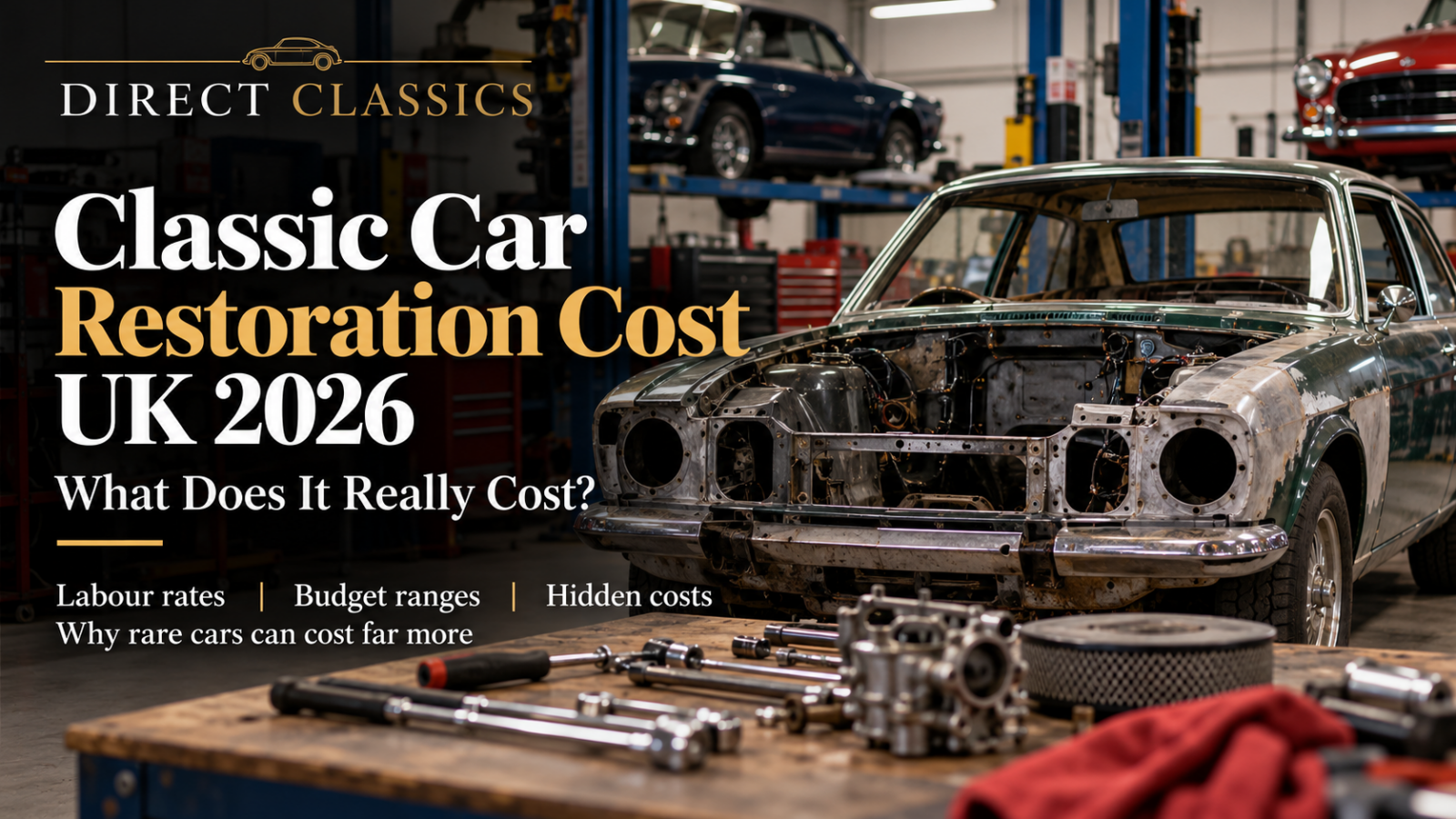
A classic car can look like a bargain when it first appears in a garage, barn or auction listing.
The purchase price, however, is only the beginning.
Once a restoration starts, corrosion can appear beneath paint, engines can reveal internal damage, wiring may need replacement and apparently simple missing trim pieces can become surprisingly difficult to find.
So, how much does it actually cost to restore a classic car in the UK in 2026?
The answer depends heavily on the individual car, its condition, the standard of restoration required and the availability of parts.
A relatively complete car may need only recommissioning and mechanical repairs. A badly deteriorated vehicle may require hundreds of hours of specialist labour, fabrication, paintwork, engine work and parts sourcing.
And with a particularly rare classic, there may be no sensible way to calculate the final cost before work begins.
The most useful question is therefore not simply “How much does a restoration cost?”
It is:
Contents
Classic Car Restoration Cost UK: 2026 Planning Guide
No table can tell you exactly what your car will cost to restore, but broad planning bands can help show the difference between recommissioning and a complete professional rebuild.
| LEVEL | ROUGH BUDGET | WHAT IT MAY INVOLVE |
|---|---|---|
| Recommissioning | £2,000–£8,000+ | Servicing, brakes, tyres, battery, fluids, hoses, minor electrical repairs and getting a fundamentally sound car back into reliable use. |
| Targeted restoration | £8,000–£30,000+ | Mechanical rebuilding, localised welding, selected bodywork, paint repairs, interior work and replacing missing or worn components. |
| Full professional restoration | £30,000–£100,000+ | Major disassembly, structural repairs, fabrication, body preparation, paint, drivetrain, suspension, brakes, wiring, interior, brightwork and detailed reassembly. |
| Rare / coachbuilt / exceptional project | No useful universal ceiling | Parts may need international sourcing, rebuilding, remanufacture or fabrication. Specialist knowledge and donor vehicles may also become necessary. |
How Much Does Classic Car Restoration Labour Cost in the UK?
Labour is one of the biggest costs in a professional restoration.
Published UK workshop rates in 2026 show how much specialist work can vary.
| UK SPECIALIST | PUBLISHED RATE | TYPE OF WORK |
|---|---|---|
| ADO Restoration | £62 per hour + VAT | Workshop labour |
| Classic & Retro Autos | From £65 per hour + VAT | Mechanical work |
| Classic & Retro Autos | £80 per hour + VAT | Welding and fabrication |
| Classic & Retro Autos | £110 per hour + VAT | TIG aluminium welding and fabrication |
| Village Classic Car Company | £75 per hour + VAT | Specialist restoration labour |
| Bridge Classic Cars | £95 per hour + VAT | Workshop labour |
These are examples of publicly advertised rates rather than a UK-wide standard rate.
The important point is that restoration projects can consume a very large number of labour hours.
Metal fabrication, panel alignment, stripping, preparation and final assembly can all take considerably longer than a customer might expect simply from looking at the finished vehicle.
1. Assessment and Strip-Down
The first stage of a restoration should establish what you actually own.
A car may look relatively complete from above while hiding significant problems underneath carpets, trim, underseal or previous repairs.
A specialist may begin with a visual inspection and then move to a more invasive assessment if the project requires it.
More detailed assessments can involve removing trim, rust, paint or other coverings so the real extent of the restoration becomes clearer.
Even after that, an estimate remains an estimate.
2. Bodywork, Welding and Hidden Corrosion
Corrosion is one of the biggest reasons a restoration budget can change.
A bubbling sill or small area of visible rust can hide considerably more deterioration behind the outer panel.
Once paint, filler, underseal and previous repairs are removed, a workshop may discover:
- corroded inner sills;
- floor damage;
- poor previous welding;
- rust around suspension mounting points;
- corroded wheel arches;
- damaged chassis sections;
- water-damaged panels; or
- panels that require complete replacement.
This is also where the difference between a common classic and a rare car becomes significant.
If a replacement panel is readily available, the job may be relatively straightforward.
If no replacement exists, somebody may have to repair the original panel or manufacture what is needed.
3. Paintwork Can Be Much More Than a Respray
Owners sometimes think of paint as the simple final stage of restoration.
In reality, much of the cost can come from what happens before the final colour coat.
Professional paintwork may involve:
- removing trim;
- stripping existing finishes;
- repairing corrosion;
- correcting old repairs;
- panel alignment;
- surface preparation;
- priming;
- blocking and preparation;
- colour application;
- clear coat where appropriate;
- finishing and polishing; and
- careful reassembly.
The standard required also matters.
A usable driver does not necessarily require the same preparation and finish as a concours-level restoration.
4. Engine, Gearbox and Mechanical Restoration
A non-running engine is one of the largest unknowns in many restoration projects.
The problem might be relatively minor.
Or the engine may require complete dismantling and rebuilding.
Mechanical restoration can potentially involve:
- engine removal;
- engine rebuild;
- cylinder-head work;
- cooling-system overhaul;
- carburettor or fuel-injection work;
- gearbox repairs;
- clutch replacement;
- differential work;
- brakes;
- steering;
- suspension;
- wheel bearings; and
- exhaust components.
One fault can also lead to another decision.
Do you rebuild the original component?
Find a replacement?
Search for a donor vehicle?
Or manufacture something that is no longer available?
Each route can produce a very different cost.
5. Interior and Trim Costs
Interiors can become particularly difficult on uncommon vehicles.
Seats and carpets can often be retrimmed, but model-specific components may be much harder to replace.
Examples include:
- dashboard trim;
- door cards;
- switches;
- instrument surrounds;
- wood veneer;
- headlining fittings;
- seat mechanisms;
- badges;
- clips and fasteners; and
- unique interior mouldings.
If the original part cannot be bought, the restoration may move from simple replacement into repair, remanufacture or fabrication.
6. Electrical Restoration
Old wiring can introduce another layer of work.
A vehicle that has passed through several owners may also contain decades of repairs, accessory wiring and modifications.
Problems can include:
- brittle insulation;
- poor earths;
- corroded connectors;
- damaged fuse boxes;
- rodent damage;
- failed switches;
- charging-system faults;
- lighting problems; and
- previous non-standard wiring.
Electrical diagnosis also consumes labour even when the replacement component itself costs very little.
7. Parts Availability Can Completely Change the Cost
Parts availability is one of the biggest differences between restoring a common classic and restoring a rare one.
| COMMON CLASSIC | VERY RARE CLASSIC |
|---|---|
| Replacement panels may be available from stock. | Original panels may no longer exist commercially. |
| Several suppliers may offer mechanical components. | A single used component may take months to locate. |
| Owners’ clubs may know established repair solutions. | Specialist knowledge may exist with only a handful of people. |
| Trim may be reproduced. | Original trim may need repair or recreation. |
| A replacement component can often be ordered. | The only practical source may be another complete donor vehicle. |
This is why simply comparing workshop labour rates does not tell you what a rare restoration will cost.
A £50 component that is available immediately is one thing.
A component that does not exist is an entirely different problem.
8. Why Very Rare Classic Cars Can Be Impossible to Price Accurately
This is where normal restoration cost guides become much less useful.
Imagine that only a very small number of a particular model survive.
A specialist begins dismantling the car and discovers that a model-specific component cannot be reused.
If nobody manufactures a replacement, several possibilities remain:
- search worldwide for a used part;
- buy new-old-stock if any survives;
- repair the damaged original;
- commission a one-off replacement;
- adapt another component where appropriate; or
- find a donor car.
Until the required component is found, it may be impossible to know its final price.
The delay itself can also affect the wider project.
Direct Classics Case Study: Our Volvo 265 GLE
- engine removal;
- diagnostic and inspection time;
- sourcing the correct replacement;
- purchasing a donor vehicle;
- removing the donor engine;
- preparing the replacement unit;
- cleaning and preparing the engine bay; and
- installation and recommissioning.
What Usually Makes a Classic Car Restoration Expensive?
| COST DRIVER | WHY THE COST CAN GROW |
|---|---|
| Hidden corrosion | The full extent may only appear once paint, filler, trim and underseal are removed. |
| Labour hours | Restoration involves skilled manual work that can take hundreds of hours on a major project. |
| Parts availability | Rare components may need worldwide sourcing, repair or remanufacture. |
| Previous repairs | Poor historic repairs may need undoing before correct restoration work can begin. |
| Engine and drivetrain | Internal damage may not become apparent until dismantling and inspection. |
| Finish standard | Concours preparation can require considerably more labour than a good driver-quality restoration. |
| Missing components | Finding correct original parts for a rare vehicle can become a project in itself. |
Why Do Restoration Workshops Struggle to Give a Fixed Price?
Because they cannot reliably price work they cannot yet see.
Previously unknown faults, corrosion and damage can appear as work progresses.
The condition beneath a vehicle’s exterior cannot always be known until dismantling begins.
This is not necessarily a sign that a restoration workshop does not understand the job.
It is often the opposite.
An experienced restorer understands how much can remain hidden.
Is It Financially Worth Restoring a Classic Car?
Not every restoration makes financial sense if you compare the finished value with the total amount spent.
A £10,000 car does not automatically become a £40,000 car simply because somebody spends £30,000 restoring it.
But financial return is not the only reason people restore classics.
A restoration may make sense because:
- the car has personal or family history;
- the specification is exceptionally rare;
- very few examples survive;
- the owner wants to preserve the original vehicle;
- the restoration process itself is part of the enjoyment;
- the car cannot simply be replaced with an equivalent example; or
- preserving the car matters more than making a profit.
Buying a Finished Car Can Sometimes Be Cheaper
If your only goal is to own and drive a particular model, purchasing the best completed example you can afford can sometimes cost less than buying a poor project and paying for a complete professional restoration.
However, that calculation changes when the car itself has significance.
You cannot always replace a rare specification, known-history car or vehicle with personal importance simply by buying another one.
How Should You Budget for a Classic Car Restoration?
Instead of asking a workshop for one final number at the beginning, break the project into stages.
| STAGE | WHAT TO BUDGET FOR |
|---|---|
| 1 | Assessment: Understand the car’s basic condition before committing to major work. |
| 2 | Strip-down: Discover corrosion, previous repairs and missing components. |
| 3 | Structure and body: Complete the work required to create a sound foundation. |
| 4 | Mechanical: Engine, gearbox, suspension, steering, brakes and cooling. |
| 5 | Paint and finish: Decide the standard appropriate for the car and its intended use. |
| 6 | Interior and trim: Identify rare components before assuming replacements exist. |
| 7 | Reassembly and testing: Allow time for adjustments and faults discovered during final commissioning. |
Keep a Contingency
A restoration budget without any allowance for unexpected discoveries is unlikely to remain realistic.
The more dismantling required and the rarer the vehicle, the more important that contingency becomes.
Can You Save Money by Restoring a Classic Car Yourself?
Potentially, yes.
Labour is a major component of professional restoration costs, so an owner with the correct skills, tools, facilities and experience can reduce the amount of paid workshop time.
However, DIY restoration does not eliminate:
- parts costs;
- paint and materials;
- machine work;
- specialist fabrication;
- engine machining;
- upholstery;
- chroming or plating;
- specialist tools;
- storage; or
- work that must eventually be corrected if it was carried out incorrectly.
Safety-critical work also needs the appropriate knowledge and competence.
Frequently Asked Questions About Classic Car Restoration Costs
How much does a full classic car restoration cost in the UK?
A comprehensive professional restoration can readily cost tens of thousands of pounds. A broad 2026 planning range of around £30,000–£100,000+ can be useful for understanding the potential scale of a full restoration, but the individual vehicle can fall below or well above that range.
How much does it cost to recommission a classic car?
A complete and structurally sound car that mainly requires servicing, tyres, brakes, battery, fluids and relatively minor repairs might fall into a broad planning range of around £2,000–£8,000+. Significant faults can quickly move the project beyond that level.
Why is classic car restoration so expensive?
Professional restoration requires large amounts of skilled labour. Metal fabrication, corrosion repair, paint preparation, mechanical rebuilding, parts sourcing and careful reassembly can consume hundreds of workshop hours on a major project.
How much do UK classic car restoration workshops charge per hour?
There is no standard UK rate. Published rates vary significantly depending on the workshop and type of work, with specialist fabrication often costing more than general mechanical labour.
Why can’t a restorer give me an exact quote immediately?
Because significant corrosion, damage, poor previous repairs and internal mechanical problems may remain hidden until the car is stripped or dismantled.
Are rare classic cars more expensive to restore?
They can be. The labour may not always be fundamentally different, but parts availability can completely change the project. Rare components may require international sourcing, repair, custom fabrication, remanufacture or even a complete donor vehicle.
Can parts cost more than the car?
On some projects, yes. The purchase price of a restoration project does not necessarily reflect the cost of returning it to good condition.
Is it cheaper to restore a car or buy one already restored?
If the objective is simply to own the model, buying a well-restored example can sometimes be cheaper than paying for a complete restoration. However, rarity, provenance, sentimental value and the enjoyment of restoring the original car can change that decision.
Should I restore a classic car to concours condition?
Not automatically. The correct restoration standard depends on the car, its originality, its intended use and what the owner wants to achieve. A carefully preserved or high-quality driver can sometimes be more appropriate than a complete concours rebuild.
There Is No Single Price for Restoring a Classic Car
A useful restoration budget begins with an inspection, not a generic price list.
A straightforward recommissioning might cost a few thousand pounds.
A full professional rebuild can move deep into five figures.
And a particularly rare vehicle with major corrosion, missing components or unavailable parts can become considerably more expensive.
The most important variables are:
- the vehicle’s actual condition;
- how much corrosion remains hidden;
- the amount of skilled labour required;
- the condition of the engine and drivetrain;
- parts availability;
- the required standard of finish; and
- what the workshop discovers once dismantling begins.
Our Volvo 265 GLE demonstrated this perfectly.
What begins as an assessment of a long-stored classic can develop into engine removal, further investigation and the search for a suitable donor car.
That does not necessarily make the restoration a bad decision.
It simply shows why preserving unusual and increasingly rare cars cannot always be reduced to a simple price-per-job calculation.
At Direct Classics, the aim is not simply to make an old vehicle look presentable. It is to understand the car, preserve what can be preserved and make sensible decisions as the true condition of the project becomes clear.
Sources and 2026 UK Restoration Rates
| SOURCE | INFORMATION |
|---|---|
| Bridge Classic Cars | Workshop rate and restoration estimate terms → |
| ADO Restoration | Restoration labour rates and FAQ → |
| Classic & Retro Autos | Mechanical, welding and specialist fabrication rates → |
| Village Classic Car Company | Published restoration labour information → |
| 182 Classic Motors | Restoration assessment and inspection stages → |
Comments
Seen one of these?