
October 23, 2026
How to Research the History of a Classic Car in the UK: 12 Ways to Trace Its Past
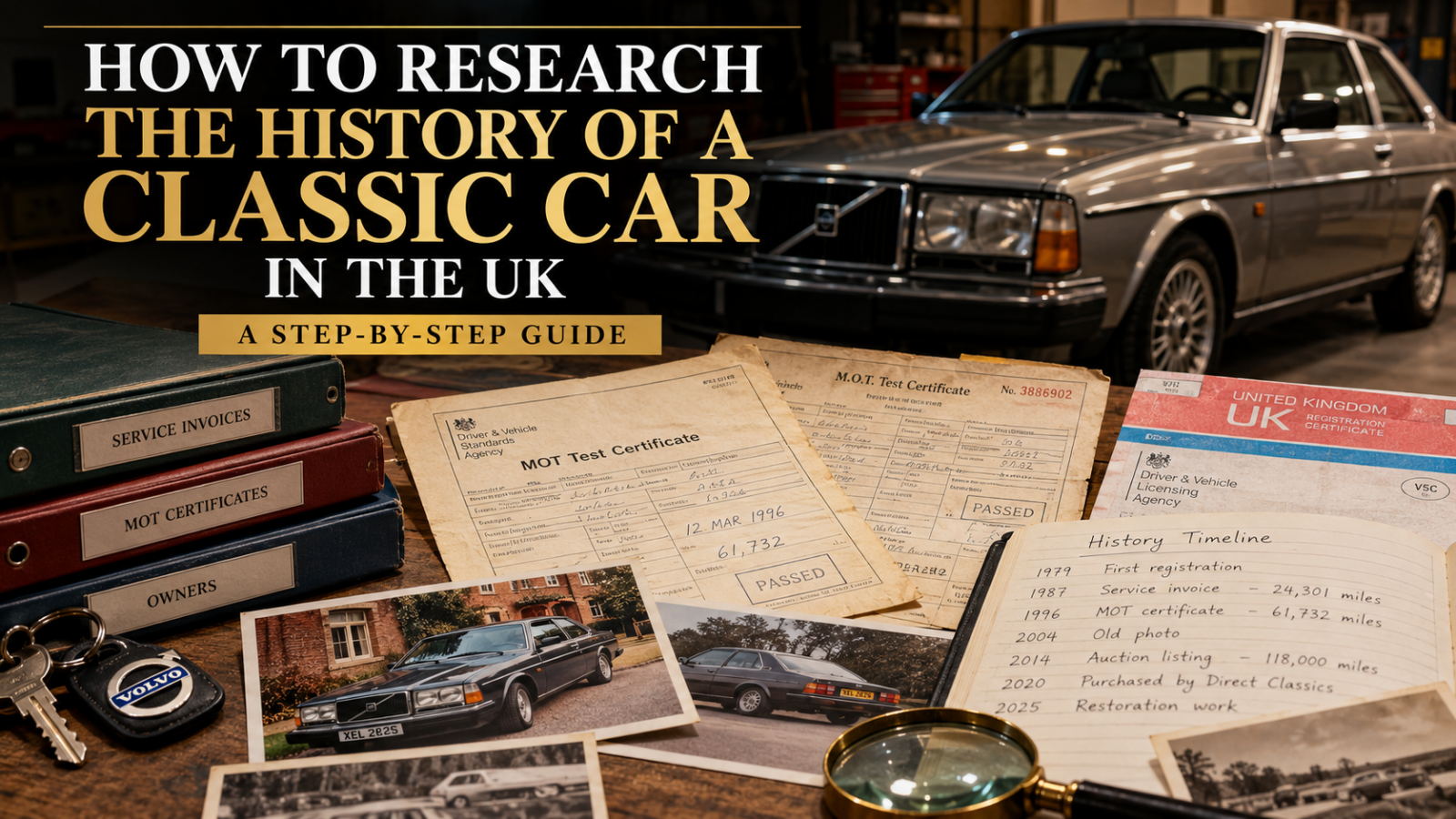
One of the most interesting parts of owning an old car is discovering where it has been before it reached you.
With a modern vehicle, a history check can often provide a useful overview within minutes. A classic car can require considerably more detective work.
Old MOT certificates, chassis numbers, service invoices, factory records, owners’ clubs, auction photographs and even an old number plate can all reveal another part of the story.
So, how do you research the history of a classic car in the UK?
The answer is to avoid relying on one database. Instead, collect evidence from several sources and gradually build a timeline for the individual vehicle.
| QUICK ANSWER
Start with the registration number, official DVLA vehicle information and MOT history. Then compare the V5C, chassis or VIN, engine number, old MOT certificates, invoices, photographs and previous registration numbers. For some marques, factory archives and owners’ clubs can provide another important layer of information. |
The most important principle is simple:
| DO NOT TRY TO PROVE A CLASSIC CAR’S ENTIRE HISTORY WITH ONE RECORD.
Build the story from several pieces of evidence and record what each one actually proves. |
Contents
Classic Car History Check: 12 Places to Look
| STEP | WHERE TO LOOK | WHAT IT MAY REVEAL |
|---|---|---|
| 1 | Registration number | Basic DVLA vehicle information and a starting point for further research. |
| 2 | MOT history | Recorded mileage, passes, failures, advisories and test dates from the available digital period. |
| 3 | V5C | Registration and vehicle details that you can compare with the physical car. |
| 4 | Chassis or VIN | The individual vehicle identity used when researching factory records and archives. |
| 5 | Old MOTs and documents | History that may pre-date the online MOT database. |
| 6 | Previous registration numbers | Older adverts, photographs, show appearances and online references. |
| 7 | Service invoices | Dates, mileage, garages, repairs, parts and sometimes previous addresses. |
| 8 | Factory archives | Original specification, build dates, engine or body numbers and destination where records survive. |
| 9 | Owners’ clubs | Model registers, marque knowledge and information from enthusiasts familiar with the car. |
| 10 | Online searches | Forums, old listings, photographs, social posts and previous sale adverts. |
| 11 | Auction archives | Older photographs, descriptions, mileage claims and previous condition. |
| 12 | Your own timeline | A clear chronological record of what you know, what you believe and what remains unverified. |
1. Start With the Registration Number
The registration number is usually the easiest starting point for researching a UK classic.
The official DVLA vehicle enquiry service can provide information held against a registration, including details such as:
- date of first registration;
- year of manufacture;
- engine size;
- fuel type;
- current tax or SORN status;
- MOT expiry where applicable;
- last V5C issue date; and
- other vehicle information held by DVLA.
This does not provide a complete history, but it gives you a useful reference point against which to compare the car and its paperwork.
Check vehicle information through GOV.UK →
| CHECK FOR DISCREPANCIES
If the paperwork says one engine capacity, colour, manufacture year or identity and the physical car appears to tell another story, do not simply ignore the difference. Record it and investigate further. |
2. Check the MOT History — But Understand Its Limits
The government’s online MOT history service is one of the most useful free tools when researching a vehicle in Great Britain.
It can show previous MOT results, recorded mileage, failures and defects from the period covered by the digital records.
For cars, motorcycles and vans in England, Scotland and Wales, the online service provides results for tests carried out since 2005.
This creates an important limitation when researching older cars.
| NO MOT HISTORY BEFORE 2005 DOES NOT MEAN THE CAR HAD NO HISTORY.
A 1970s or 1980s classic may have spent decades on the road before the period covered by the current online MOT database. |
That is why old paper MOT certificates can become valuable historical evidence.
Check a vehicle’s MOT history through GOV.UK →
What Can MOT History Tell You?
| INFORMATION | WHY IT IS USEFUL |
|---|---|
| Mileage | Allows you to compare recorded mileage between tests. |
| Test dates | Shows periods when the vehicle appears to have been presented for MOT testing. |
| Failures | May reveal recurring mechanical or structural problems. |
| Advisories and defects | Can provide clues about deterioration and previous maintenance needs. |
3. Study the V5C and Compare It With the Car
The V5C registration certificate is another important starting point.
When buying a vehicle, GOV.UK advises checking that the V5C details match the vehicle and specifically recommends checking the vehicle identification number and engine number.
For a classic car, compare the paperwork carefully with the physical vehicle.
| COMPARE | WITH |
|---|---|
| Registration number | Number plates and supporting documents. |
| Chassis / VIN | The number physically present on the vehicle. |
| Engine information | The engine currently installed where the number is identifiable. |
| Colour | Current finish and evidence of previous colours. |
| Vehicle details | Make, model and other recorded information. |
| REMEMBER
A V5C is an important registration document, but researching provenance means going beyond one document and comparing several independent sources. |
4. Find the Chassis Number or VIN
The registration number can change during a vehicle’s life.
The chassis number or VIN gives you another way to identify and research the individual car.
This becomes particularly important when dealing with:
- private registration plates;
- imported vehicles;
- cars that have changed registrations;
- factory archive searches;
- heritage certificate applications; and
- vehicles with incomplete paperwork.
Where the manufacturer used additional engine, body or gearbox numbers, record those too.
Do not assume every old vehicle will use exactly the same identification system as a modern car. Identification formats differ between manufacturers and periods.
Photograph the Identification Numbers
Take clear photographs of the numbers as you find them.
Also record exactly where each number appears on the vehicle.
This creates a useful reference when comparing the car with factory records and historic documents later.
5. Search for Old MOTs, Tax Discs and Paperwork
For a classic car, a box of old paperwork can sometimes tell you more than an online vehicle-history report.
Do not discard documents simply because they look old or insignificant.
| DOCUMENT | POSSIBLE CLUE |
|---|---|
| Old MOT certificate | Date, mileage and registration information from before the online period. |
| Tax disc | A dated piece of evidence connected with the vehicle and its registration. |
| Service book | Dates, mileage and supplying or servicing dealers. |
| Repair invoice | Workshop, date, registration, mileage and repairs carried out. |
| Old insurance paperwork | Potential dates, registrations and vehicle descriptions. |
| Old photograph | Condition, colour, number plate, accessories and period context. |
One document may prove very little by itself.
Several documents from different years can begin to establish a much clearer history.
6. Research Every Registration Number Connected With the Car
A classic car may not have worn the same number plate throughout its entire life.
It could have carried a private registration, later returned to another registration or had a different identity while overseas.
If you discover an earlier registration number in an invoice, photograph or old MOT certificate, record it.
Then search that registration separately.
An old number can sometimes uncover:
- historic photographs;
- forum discussions;
- previous sale advertisements;
- auction listings;
- club references;
- show appearances; or
- social-media photographs.
| USE OLD REGISTRATIONS AS SEARCH TERMS
Searching only the car’s current registration can leave years of its online history undiscovered. |
7. Read Old Service and Repair Invoices Properly
An invoice is not only a record of what somebody spent on the car.
It can contain several useful pieces of historical evidence at once.
Look for:
- invoice date;
- recorded mileage;
- registration number;
- garage or dealership;
- parts fitted;
- repairs undertaken;
- engine or chassis information;
- owner information where legitimately contained in your own records; and
- notes about the vehicle’s condition.
A sequence of invoices can help establish where the car was maintained and how its mileage developed over time.
Specialist garage names can also lead to further research.
A business that maintained a rare car for many years may still exist, or its name may appear in marque-club archives and historic advertisements.
8. Check Whether a Factory or Heritage Archive Exists
One of the biggest advantages of researching some classic marques is the survival of original factory records.
What survives varies considerably between manufacturers.
For certain vehicles, an archive may be able to confirm details such as:
- build date;
- dispatch date;
- original colour;
- original trim;
- engine number;
- body number;
- gearbox number;
- factory equipment; and
- original destination.
Jaguar and Daimler
The Jaguar Daimler Heritage Trust holds original production records for Jaguar and records for some Daimler vehicles.
Its Heritage Certificates use the surviving production records to document information associated with the original chassis number.
Importantly, the Trust itself explains that a Heritage Certificate documents factory-record information. It does not by itself prove the present vehicle’s identity, ownership, originality or condition.
Jaguar Daimler Heritage Trust Certificates →
British Motor Industry Heritage Trust
The archive at the British Motor Museum holds original factory records for numerous British manufacturers.
Its collections include records covering marques such as Austin, MG, Morris, Rover, Triumph, Land Rover and Range Rover, although the years covered differ between models and manufacturers.
Where a factory record survives, a Heritage Certificate can document information recorded when the individual car left production.
British Motor Museum Heritage Certificates →
| FACTORY RECORD ≠ COMPLETE LIFE HISTORY A factory archive may tell you how the car began its life. Service records, MOTs, photographs, invoices and later documentation are still needed to research what happened afterwards. |
9. Contact the Relevant Owners’ Club
Owners’ clubs can be an extremely useful resource when researching an unusual classic.
A marque or model club may have:
- model registers;
- technical records;
- period magazines;
- historic photographs;
- knowledge of surviving examples;
- members who recognise the car; or
- specialists familiar with chassis and production information.
This can become particularly valuable for rare models where only a small enthusiast community has followed the surviving cars over several decades.
When contacting a club, give them useful information rather than simply asking, “Do you know this car?”
| USEFUL INFORMATION | WHY INCLUDE IT |
|---|---|
| Model and year | Narrows the vehicle down immediately. |
| Registration | May match an existing club record or photograph. |
| Chassis number | Can help specialists identify the individual vehicle accurately. |
| Previous registration | May reveal older records under another identity. |
| Period photographs | Can help people recognise a known car. |
10. Search the Registration and Chassis Number Online
A normal internet search can reveal surprising amounts of information about a classic vehicle.
Search the registration number in quotation marks so the search engine looks for that exact sequence.
Then repeat the process using:
- previous registration numbers;
- the chassis number;
- model and registration together;
- model and chassis number together;
- registration plus “auction”;
- registration plus “for sale”;
- registration plus “club”;
- registration plus “show”; and
- registration plus the name of an old garage or dealer.
Do Not Ignore Old Forum Posts
A discussion from 2008 may be more valuable to your research than a newly published page.
Forums can contain old ownership discussions, restoration photographs, technical conversations and references to cars that disappeared from public view years ago.
Always distinguish between evidence and somebody’s recollection, however.
An old photograph clearly showing the registration is stronger evidence than a forum comment saying that somebody “thinks” they remember the vehicle.
11. Search Auction Archives and Previous Sale Listings
Classic cars often leave a digital trail when they change hands.
Search auction-house archives, specialist dealers and old classified listings for both the registration and chassis number.
A previous listing may contain:
- photographs from several years ago;
- recorded mileage;
- condition descriptions;
- restoration claims;
- previous colours;
- ownership claims;
- service-history descriptions; and
- information about earlier sales.
| TREAT SALE DESCRIPTIONS AS CLAIMS UNTIL VERIFIED
An old advertisement is useful evidence of how the vehicle was described at that time. It does not automatically prove every statement made in the advertisement. |
Compare the Photographs
Photographs can sometimes tell you more than the written description.
Compare:
- paint colour;
- wheels;
- interior;
- badges;
- number plates;
- body damage;
- engine bay;
- accessories; and
- restoration progress.
A set of photographs from ten or twenty years ago can provide an extremely useful record of how a car has changed.
Can DVLA Tell You Who Previously Owned a Classic Car?
This area needs careful explanation.
DVLA holds registered keeper information, but previous keeper identities are not an open public-search database.
DVLA provides forms for requesting information from its vehicle records, including form V888 for individuals.
However, access to information about another registered keeper requires an appropriate reason, and DVLA applies restrictions to the release of personal information.
Current registered keepers can also request certain information relating to their own vehicle, but the information DVLA can release depends on the circumstances and the reason for the request.
| DO NOT ASSUME YOU CAN BUY A LIST OF PREVIOUS OWNERS FROM DVLA
Keeper information involves personal data. Check the current DVLA rules and use the appropriate official process rather than relying on outdated advice found on forums. |
Read the current DVLA vehicle-information rules →
12. Build a Timeline Instead of Keeping Random Documents
Once you begin finding information, organise it chronologically.
This is where separate scraps of history begin to become a coherent vehicle story.
Example Classic Car History Timeline
| DATE | EVIDENCE | WHAT IT TELLS US |
|---|---|---|
| 1979 | Factory / registration record | Production or first-registration information. |
| 1987 | Service invoice | Recorded mileage, garage and maintenance work. |
| 1996 | Old MOT certificate | Registration and mileage from before digital MOT records. |
| 2008 | Online MOT history | Mileage and vehicle condition recorded during testing. |
| 2014 | Old sale advertisement | Photographs, condition and how the car was described at the time. |
| 2026 | Current inspection | Present specification, mileage and condition. |
Add an Evidence Rating
Not every piece of information deserves the same confidence.
| EVIDENCE | HOW TO TREAT IT |
|---|---|
| Original factory record | Strong evidence for the information actually recorded by the manufacturer. |
| Official DVLA / MOT record | Strong evidence for the information recorded by that system at the relevant time. |
| Dated invoice | Useful evidence of work, mileage or vehicle details recorded on that date. |
| Dated photograph | Strong visual evidence of appearance at a point in time. |
| Old sale advert | Useful historical evidence, but its claims still need verification. |
| Owner recollection | Potentially valuable, but distinguish memory from documented evidence. |
Direct Classics Example: Researching a Volvo 262C Bertone
| DIRECT CLASSICS COLLECTION
Our collection includes a 1979 Volvo 262C Bertone showing just 21,983 recorded miles. Direct Classics acquired the car on 17 July 2020. A car such as the 262C is a good example of why classic-car research should use several sources. Its individual vehicle history sits alongside a wider model story involving Volvo, Bertone production in Italy and relatively small production numbers. Researching an individual example means separating those two subjects: MODEL HISTORY VEHICLE HISTORY That distinction prevents general model information from being mistaken for proof about one individual car. |
What a Classic Car History Check Cannot Automatically Prove
This is where classic-car research often goes wrong.
A history file can be extensive without proving every claim made about a vehicle.
| CLAIM | WHAT YOU SHOULD LOOK FOR |
|---|---|
| “Matching numbers” | Factory records and the numbers physically present on the car. |
| “Original mileage” | A continuous sequence of MOTs, invoices, service records and other dated mileage evidence. |
| “Original colour” | Factory records, paint codes and physical evidence on the vehicle. |
| “One owner” | Appropriate documented evidence rather than an unsupported advert description. |
| “Never restored” | Detailed physical inspection supported by historic photographs and documentation. |
| PROVENANCE SHOULD BE DOCUMENTED, NOT ASSUMED.
When evidence does not prove something, describe it as unknown or unverified rather than filling the gap with an assumption. |
How Do You Verify the Mileage of a Classic Car?
This deserves particular attention because an odometer reading and a verified mileage are not necessarily the same thing.
For a modern car, a long sequence of MOT mileage readings can make comparisons relatively straightforward.
With a much older vehicle, the digital MOT record may only represent the later part of its life.
Try to build a mileage sequence using:
- online MOT readings;
- old paper MOT certificates;
- service-book stamps;
- dated repair invoices;
- dealer records;
- previous advertisements; and
- dated photographs of the instruments where available.
If there is a 15-year gap in the evidence, say there is a gap.
Do not turn a recorded odometer reading into a guaranteed lifetime mileage unless the available evidence genuinely supports that conclusion.
This is why wording such as “21,983 recorded miles” can be more appropriate than making a stronger claim that the surviving documentation cannot prove.
Researching a Classic Before You Buy It
If you are researching a car before purchase, compare the seller’s description with independent information.
GOV.UK recommends checking that the seller’s vehicle details match DVLA information and that the MOT history matches the information provided. It also advises inspecting the V5C and checking the identification and engine numbers.
For a classic, take that process further.
| SELLER SAYS | CHECK AGAINST |
|---|---|
| “Very low mileage” | MOT history, invoices and old service records. |
| “Original engine” | Engine number and available factory documentation. |
| “Original colour” | Factory records, paint information and physical inspection. |
| “Full history” | The actual dates and documents included in the history file. |
| “Rare specification” | Manufacturer records and reliable marque-specific sources. |
See the official GOV.UK vehicle-buying checks →
Frequently Asked Questions About Classic Car History Checks
How can I check the history of an old car in the UK?
Start with the registration number and use the official DVLA vehicle-information and MOT-history services. Then compare the V5C, chassis or VIN, old MOT certificates, invoices, previous registrations, factory archives and any available historic photographs.
How far back does online MOT history go?
For cars, motorcycles and vans in England, Scotland and Wales, the official online MOT history service provides results for tests carried out since 2005.
That means an older classic may have decades of history that do not appear in the online MOT database.
Can I find previous owners of a classic car through DVLA?
DVLA does not provide an unrestricted public search of previous registered keepers. Requests for keeper information are subject to rules governing when DVLA can release personal information.
Use the current official DVLA process rather than assuming old advice about previous-owner requests still applies.
Can an owners’ club help trace a classic car?
Potentially. Some clubs maintain model registers, period publications or specialist knowledge and may recognise a registration or chassis number. What each club holds varies considerably.
Can I research a classic car using its chassis number?
Yes. The chassis or VIN can be particularly useful when contacting manufacturer archives, heritage organisations and model specialists because registration numbers can change during a vehicle’s life.
Why does my classic car have no old MOT history online?
The absence of online results from the earlier part of a classic car’s life does not necessarily indicate a problem. The current Great Britain online MOT service only provides car, motorcycle and van test results from 2005 onward.
How can I prove a classic car’s mileage?
Build a chronological mileage record using as many independent dated sources as possible, including MOT records, old certificates, service books, invoices and historic advertisements. If the evidence has gaps, describe the mileage carefully rather than claiming more than the records prove.
What is a classic car Heritage Certificate?
For marques with surviving factory records, a recognised heritage archive may be able to issue a certificate reproducing information from the original production record. The information available depends on the manufacturer, model and surviving records.
Does a Heritage Certificate prove a car is completely original?
No. For example, the Jaguar Daimler Heritage Trust specifically explains that its certificate records information from the original production records but does not itself confirm the present vehicle’s identity, originality, ownership or current condition.
Can old auction listings help research a classic?
Yes. An old listing can provide dated photographs, mileage, specification and a description of the car at that point in time. Treat statements in the advert as historical claims unless separate evidence confirms them.
A Classic Car’s History Is a Puzzle, Not a Single Report
The older the vehicle, the less likely one database is to tell its complete story.
Start with official records, but do not stop there.
Compare the registration, chassis number and V5C. Study the MOT history. Preserve old invoices and paper MOT certificates. Search previous registrations. Contact relevant factory archives and owners’ clubs. Look through auction listings and old photographs.
Most importantly, record where every piece of information came from.
A strong history file should make it possible to distinguish between:
- what the available evidence proves;
- what the evidence strongly suggests;
- what a previous owner or seller claimed; and
- what remains unknown.
That approach does more than create a thicker history folder.
It preserves the story of the individual vehicle for the next owner and for the enthusiasts who may be researching it decades from now.
At Direct Classics, we believe the history surrounding an unusual classic can be just as interesting as the car itself, particularly when a vehicle has survived for several decades or returned to the road after long-term storage.
Explore our 1979 Volvo 262C Bertone →
Official Sources and Further Research
| SOURCE | WHAT IT IS USEFUL FOR |
|---|---|
| GOV.UK – DVLA Vehicle Information | Check information held against a registration → |
| GOV.UK – MOT History | Check previous MOT results and recorded mileage → |
| GOV.UK – DVLA Record Requests | Current rules for requesting information from DVLA → |
| Jaguar Daimler Heritage Trust | Jaguar and Daimler heritage archive services → |
| British Motor Museum | British Motor Industry Heritage Trust records → |
| Classic vehicle records vary considerably according to age, manufacturer and individual history. A missing document or online record does not automatically prove that an event did or dd not occur. Treat provenance as an evidence-gathering process and describe unverified information accordingly. |
Comments
Seen one of these?